
- All
- Product Name
- Product Keyword
- Product Model
- Product Summary
- Product Description
- Multi Field Search


Views: 0 Author: Site Editor Publish Time: 2026-10-30 Origin: Site


Worn or cracked upholstery poses an immediate compliance risk in any modern clinic. It reflects poorly on your practice's overall standard of care. Patients notice damaged equipment immediately. However, replacing an otherwise fully functional operatory setup remains an unnecessary capital expense. Clinics constantly struggle to balance strict budgets against premium patient experiences.
Upgrading your seating assembly extends the equipment lifecycle significantly. You achieve this modernization at a mere fraction of full replacement costs. Modular component swaps allow practices to maintain flawless clinical environments. They prevent the immense financial drain associated with buying brand-new operatory packages.
This guide provides a robust technical evaluation framework. It helps you match cushion shapes and identify complex mounting hardware accurately. You will learn how to select advanced medical materials. These materials perfectly balance patient comfort against strict clinical hygiene standards. Read on to master the exact steps needed for a seamless, professional upholstery upgrade.
Exact fit requires identifying the specific chair make, model, and year, as mounting patterns (bolts, tracks, or Velcro) vary significantly even within the same manufacturer.
Selecting the right dental chair cushion involves a tradeoff between seamless designs (optimized for infection control) and plush, seamed designs (optimized for patient comfort during long procedures).
Sourcing aftermarket dental chair spare parts can reduce costs by 30-50% compared to OEM, provided the vendor guarantees exact-match dimensions and medical-grade materials.
Proper material selection directly impacts surface longevity, especially when subjected to aggressive, hospital-grade dental chair disinfection protocols.
Buying a new operatory chair drains practice capital rapidly. Clinic owners should expect to spend between $8,000 and $15,000 per room for premium brands. Upgrading the upholstery kit changes this financial equation entirely. New kits require an upfront investment of just $1,000 to $2,500. This massive price difference frees up your budget for other essential clinical technologies. You restore the chair to like-new condition visually. Simultaneously, you avoid wasting money replacing perfectly functioning hydraulics and heavy internal motors.
Infection control standards grow stricter every single year. Old vinyl develops microscopic tears and hairline cracks over time. These tiny, hidden fissures harbor dangerous pathogens and bodily fluids. Routine wiping cannot sanitize deep inside a cracked porous surface. Health and safety auditors specifically inspect equipment for this exact damage. Torn upholstery practically guarantees a failed clinic inspection today. Mitigate this operational risk immediately. Install intact, medical-grade covers to maintain a compliant, safe environment.
Patients evaluate clinic cleanliness the moment they sit down. The visual state of your dental chair cushion serves as a primary trust signal. Faded, cracked, or duct-taped seating destroys professional credibility instantly. A pristine, modern cushion communicates high standards and attention to detail. It reassures anxious patients about your overall sterilization practices. They feel safe, valued, and comfortable in your care.
Time equals revenue in any active dental practice. Decommissioning an old chair takes a full day of heavy labor. Scheduling utility disconnects and moving cast-iron bases disrupts clinic flow. Installing a brand-new unit halts production even further. Modular upholstery swapping offers a vastly superior alternative. It typically takes only one to two hours per chair. Staff can schedule this straightforward maintenance during a lunch break. The clinic prevents lost production time entirely.
Ordering the correct kit requires exact equipment data. You must find the manufacturer serial number first. You also need the specific model designation. Look closely under the pump cover at the base. If the plate is missing, check beneath the main seat base. Mechanics often place data plates on the rear backrest chassis. Write down the production year carefully. Manufacturers frequently update dimensions and bolt patterns between production years. A 2005 model might differ entirely from a 2010 version.
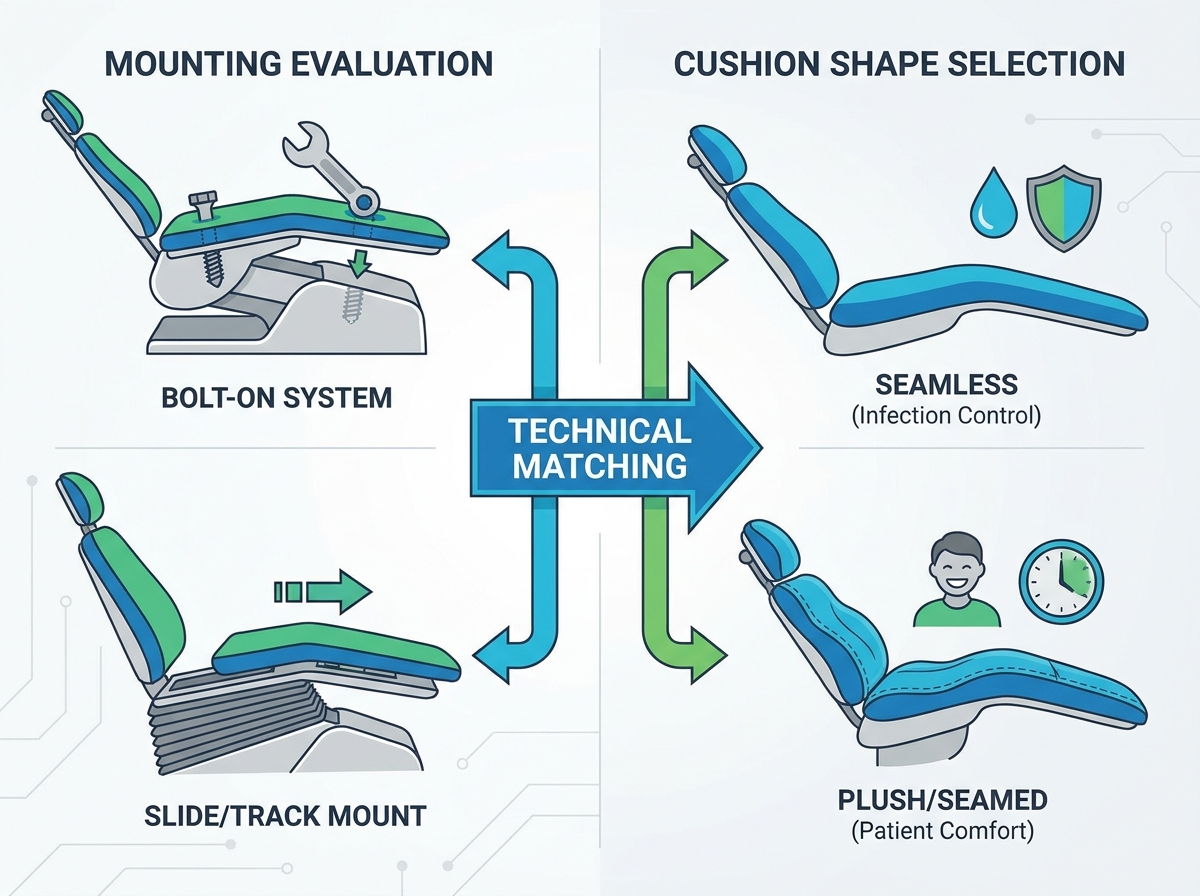
Chair brands use drastically different structural attachment methods.
Bolt-on Systems: These use standard threaded inserts hidden in the foam. A-dec and Belmont frequently employ this highly durable method. You must align the base bolts perfectly during installation.
Slide/Track Mounts: These utilize channeled backing systems. Brands like Pelton & Crane or Midmark prefer sliding metal tracks. The cover simply slides into a metal groove and locks.
Sling vs. Solid Base: Sling-style seating acts like a flexible hammock stretched across a frame. It requires specific specialized tensioning. Solid bases use rigid fiberglass or metal buckets beneath the foam. You must identify your exact base type before ordering.
Most replacement kits feature distinct modular sections. You must ensure all new components align perfectly with your existing frame.
Headrest: Supports the cervical spine securely. It often includes articulating joints or magnetic slide mounts.
Backrest: Houses essential lumbar support. It must clear the clinician's knees during rear-delivery procedures.
Seat Cushion: Bears the most patient weight. It requires dense foam to prevent bottoming out against the metal plate.
Toe Board: Protects the lower leg and heel area. Suppliers often cover it in a clear, scuff-resistant protective material.
Shape selection dictates both patient comfort and workflow efficiency.
Seamless covers wrap tightly over the foam core without visible stitching. They offer massive advantages for rapid room turnarounds. You can execute rigorous dental chair disinfection protocols effortlessly. The total lack of crevices prevents hidden bacteria buildup. However, seamless designs generally feel firmer and less luxurious to patients.
Plush or seamed models feature deep stitching and extra padding. They provide incredible ergonomic benefits for prolonged clinical treatments. Endodontic procedures and complex implant surgeries require this elevated comfort. Patients remain still and relaxed during long appointments. Yet, staff face a heightened difficulty cleaning deep crevices between patients.
Material chemistry heavily impacts your daily clinic operations.
Standard vinyl remains the dominant industry standard worldwide. It provides excellent cost-efficiency for budget-conscious clinics. Vinyl resists mechanical friction and scuffing extremely well. Unfortunately, standard vinyl shows high susceptibility to harsh hospital chemicals. Aggressive surface wipes cause plasticizers to leach out. The vinyl will dry, harden, and crack prematurely without careful maintenance.
Polyurethane, known commercially as Ultraleather™, represents a premium upgrade. Polyurethane delivers superior temperature regulation for sweaty patients. It feels significantly softer against human skin. Most importantly, it boasts immense resistance to chemical breakdown. It withstands harsh clinical wipes beautifully. This impressive durability easily justifies the premium price point.
Material Type | Primary Benefit | Chemical Resistance | Cost Profile |
|---|---|---|---|
Standard Vinyl | High friction resistance | Low to Moderate (dries out) | Economy / Standard |
Polyurethane (Ultraleather) | Temperature regulation & softness | High (resists cracking) | Premium |
Standard factory foam degrades, compresses, and flattens over time. High-density foam cores offer an exceptional return on investment. Memory foam contours exactly to the patient's unique body shape. It drastically reduces restless patient shifting during delicate procedures. Microsurgery requires absolute patient stability for clinical success. A memory foam upgrade delivers this necessary positional control.
Original Equipment Manufacturers build replacement kits specifically tailored for their own chairs.
Pros: You receive a guaranteed, factory-spec fit. You experience zero warranty conflicts with your distributor. The mounting hardware matches your existing frame flawlessly.
Cons: You pay premium pricing for the brand name. OEM vendors historically suffer from much longer lead times. They offer limited color customization for legacy chairs. Manufacturers eventually discontinue support for older chair models completely.
Reputable third-party vendors fill the large gaps left by OEMs.
Pros: You gain access to high-quality dental chair spare parts at significantly lower price points. These specialized suppliers offer broader custom color palettes. They often provide much faster shipping times. You can modernize outdated chairs easily and affordably.
Cons: You face a severe risk of dimensional misalignment. Purchasing from non-specialized overseas vendors invites operational trouble. Many discount sellers lack verifiable quality assurance processes.
Never buy from unverified aftermarket providers. We strongly recommend checking for specific, written guarantees.
Demand exact-match mounting guarantees in writing before paying.
Request verifiable medical-grade fabric certifications for local health compliance.
Insist on a minimum 1-year warranty covering seams, zippers, and stitching.
Ask for physical color swatches to match your existing operatory cabinetry.
Many clinic owners attempt in-house upgrades to save money. You primarily need standard hex keys and basic socket sets. The process seems quite straightforward initially. However, severe mechanical risks exist. You might strip the baseboard threads easily if misaligned. Novices often misalign the backrest sliding tracks. Improper headrest tensioning causes immediate patient neck pain. DIY work demands extreme patience and moderate mechanical aptitude.
Evaluate the cost-benefit of hiring a certified dental service tech. Multi-chair upgrades require coordinated, fast-paced labor. Complex sling-style chairs demand professional tensioning tools to stretch fabrics. A trained technician finishes the job flawlessly in minutes. They ensure zero mechanical damage occurs to delicate plastic cowlings. You save yourself massive frustration. It often costs much less than repairing a botched DIY attempt.
Establish strict protocols for chemical exposure immediately after installation. Your staff must know exactly which surface cleaners to use. Emphasize proper chemical dwell times on the fabric. Using unapproved, highly abrasive wipes ruins the new material quickly. It will void manufacturer warranties instantly. Improper chemicals drastically accelerate surface degradation. Train your entire team to protect this new clinical investment.
Replacing worn upholstery revitalizes your entire operatory environment. The evaluation process demands careful technical attention. First, accurately identify your specific chair model and mounting hardware. Next, balance stringent hygiene requirements against patient comfort in your shape selection. Finally, choose wisely between pricey OEM kits and vetted aftermarket suppliers.
You now possess the knowledge to make an informed, confident upgrade. Prompt your clinic management team to act immediately. Locate your chair's serial number today. Consult with a specialized upholstery provider to discuss options. Verify your exact dimensions with them. Request physical material swatches before purchasing to ensure a perfect visual match.
A: 5–10 years depending on patient volume and the aggressiveness of the chemical disinfectants used.
A: Yes, in most cases, provided the underlying chair chassis supports the thicker foam dimensions and the mounting hardware aligns.
A: No, swapping the external dental chair spare parts like cushions does not typically affect the warranty on hydraulic or electrical systems, but always verify with your equipment provider.
A: Use mild, EPA-registered cleaners recommended by the fabric manufacturer; avoid bleach-based solutions or alcohol pools that strip plasticizers from the vinyl.


