
- All
- Product Name
- Product Keyword
- Product Model
- Product Summary
- Product Description
- Multi Field Search


Views: 0 Author: Site Editor Publish Time: 2026-10-22 Origin: Site


A dental chair's suction system acts as the primary defense against clinical aerosol spread. It also serves as a leading factor in overall patient comfort and safety. Inconsistent suction severely disrupts procedural workflow. At times, the vacuum becomes overpowering to the point of iatrogenic tissue trauma. Alternatively, it might prove too weak to prevent fluids from pooling in the back of the oral cavity. Both extremes trigger severe patient anxiety, including a very real fear of choking or drowning. Consequently, practitioners simply cannot overlook evacuation mechanics during equipment upgrades.
The goal of this article is to provide clinic owners and procurement managers with an evidence-based framework. You will learn how to properly evaluate suction setups and fluid management architectures before investing in a new dental chair unit. We will explore the technical nuances separating strong and weak suction dynamics. Ultimately, understanding these parameters ensures you select equipment built for long-term clinical excellence.
Performance Reliance: A dental chair unit’s suction efficacy is fundamentally tied to the clinic's central vacuum infrastructure (wet vs. dry); standalone chair specs tell only half the story.
Dual-System Necessity: Effective clinical operation requires independent, verifiable control over both High-Volume Evacuators (strong suction) and Saliva Ejectors (weak suction).
Integration Matters: Precise dental unit air and water controls are necessary to prevent backflow, manage aerosols, and ensure consistent suction pressure during multi-step procedures.
Maintenance Realities: Look for accessible manifold traps and standardized hosing connections to minimize daily maintenance downtime and compliance risks.
Modern dentistry generates immense volumes of aerosols. High-speed handpieces and ultrasonic scalers atomize water, saliva, and blood instantly. High-volume suction remains your most effective tool for mitigating this risk. A robust system removes up to 90% of procedural aerosols before they escape the oral cavity. When evaluating equipment, pay close attention to continuous heavy draw capabilities. The system must maintain strong suction without suffering sudden pressure drops. Clinicians cannot afford vacuum lag during complex crown preparations or surgical extractions.
Best practices dictate testing equipment under simulated peak loads. A chair might perform well during single-instrument tests. However, it could falter when assistants operate multiple evacuation lines simultaneously. Ask vendors for specific data on continuous volumetric flow under heavy clinical stress.
Patient psychology heavily influences dental clinic success. Many patients harbor an unspoken fear of fluid pooling. Lying supine while water accumulates quickly triggers gag reflexes and claustrophobia. A premium system reliably clears fluids without hesitation. It must accomplish this discreetly. Excessive acoustic noise and physical vibration exacerbate dental anxiety. You want a setup functioning silently in the background.
Common mistakes include ignoring acoustic output during procurement. Loud whistling from poorly designed suction tips creates an incredibly stressful auditory environment. Always prioritize designs engineered specifically for noise reduction.
While strong suction proves essential for aerosol capture, it introduces unique physical risks. Overpowered vacuum forces cause iatrogenic mucosal trauma. The tip grabs delicate buccal tissues, causing painful bruising or micro-tears. Therefore, strong suction requires incredibly fine-tuned operator control.
Assess the ergonomics and responsiveness of slider valves located on the delivery arm. Dental assistants manipulate these valves hundreds of times daily. Smooth, responsive valves allow instant vacuum modulation. They prevent tissue damage while preserving procedural efficiency. Sticky or rigid valves force assistants to wrestle with the equipment, increasing the likelihood of accidental tissue grabs.
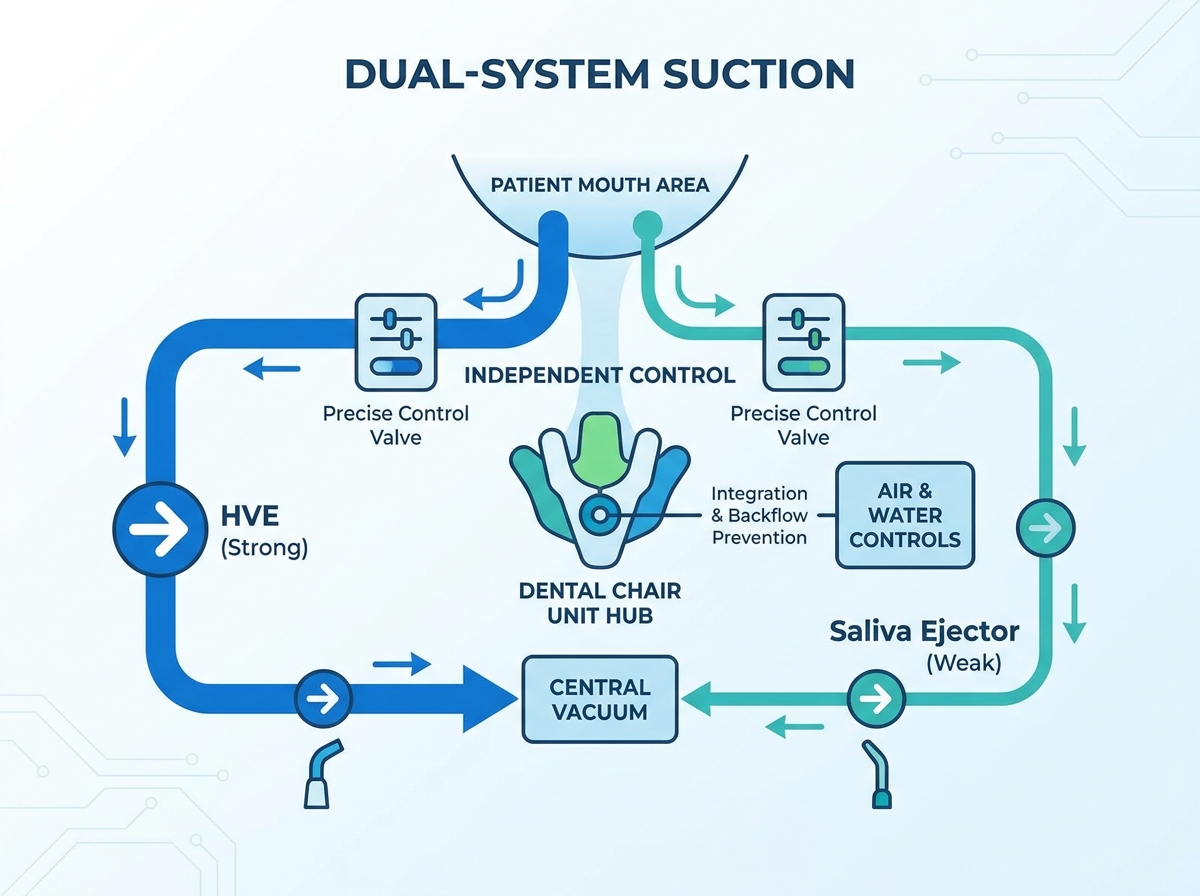
High-Volume Evacuators handle heavy fluids, debris, and vast aerosol clouds. They form the absolute backbone of strong suction mechanics. When assessing HVE standards, examine internal tubing diameters carefully. Proper sizing ensures the setup meets standard cubic feet per minute (CFM) requirements. Optimal aerosol capture depends entirely on achieving optimal CFM flow at the tip.
Next, evaluate valve durability. HVE valves face continuous, rigorous sterilization cycles. Autoclaving breaks down inferior materials rapidly. Metal valves typically outlast high-grade polymers, though polymers weigh considerably less. Balance durability against ergonomic weight. Look for internal O-rings engineered from chemical-resistant silicone rather than standard rubber. Degrading O-rings cause immediate vacuum leaks.
Saliva ejectors manage weak, continuous suction. They provide constant, low-level fluid removal while the dentist works. Begin by evaluating the baseline vacuum pressure. This pressure is measured in inches of mercury (inHg). An effective saliva ejector clears pooling reliably. Crucially, it must never compete against the HVE line for vacuum power. If activating the HVE causes the saliva ejector to stop functioning, the internal manifold design is flawed.
Review ejector placement carefully. It should sit comfortably on the assistant's instrumentation arm. Ergonomic reach drastically reduces operator fatigue during marathon procedures.
Consider these standard evaluation steps during physical demonstrations:
Verify internal tubing diameters match clinic CFM target goals.
Test all HVE slider valves for smooth, one-handed operation.
Measure baseline inHg pressure to ensure saliva ejectors function independently.
Simulate common assistant workflows to confirm ergonomic positioning.
Suction systems do not operate in a vacuum. They share the complex delivery infrastructure alongside other critical operatory elements. Examine internal routing pathways thoroughly. High-quality designs rigidly separate suction lines from clean air and water pathways. This physical separation prevents dangerous cross-contamination events. Precise dental unit air and water controls play a massive role here. They regulate fluid delivery while isolating hazardous biological waste streams.
Verify the presence and certification of anti-retraction valves. Strong suction environments create intense physical vacuum forces. These forces can inadvertently cause negative pressure in municipal or bottled water lines. Without proper isolation, contaminated fluids flow backward into clean reservoirs. Backflow prevention is a strict regulatory compliance issue globally. Ensure the equipment utilizes certified one-way valves. Check how easy these valves are to inspect and replace during annual maintenance.
Biofilm accumulation poses a severe risk in shared lines. When suction and water lines run too close together, temperature transfers can encourage bacterial growth in the clean lines. Superior engineering maintains thermal and physical distance between these conduits.
Air pressure stability proves equally important for seamless operations. Pneumatic switches govern suction activation in many modern units. These switches must operate completely independently of the primary compressor lines driving the handpieces. Ensure suction activation does not cause sudden pressure drops. A sudden drop in handpiece drive air ruins procedural precision, especially during delicate margin preparations. The entire pneumatic system must function harmoniously under absolute peak loads.
Benchmarking helps clarify realistic equipment expectations. We can use the KJ-917(25) dental chair unit as a highly effective comparative baseline. This model standardizes suction architecture for mid-tier to premium equipment. Analyzing its specific design reveals exactly what you should expect from modern, compliant systems. It balances robust vacuum channeling with user-friendly external interfaces.
Suction Component Evaluation Matrix
Component | Primary Function | Baseline Requirement | Common Failure Point |
|---|---|---|---|
HVE Valve | Regulates strong vacuum flow | Smooth slider, autoclavable | O-ring degradation causing leaks |
Saliva Ejector | Continuous fluid removal | Independent inHg pressure | Clogging at the tip adapter |
Manifold Trap | Captures large debris | Tool-free quick access | Cracked plastic housings |
Umbilical Hose | Routes utilities from floor | Kink-resistant, wide diameter | Internal collapse under vacuum |
Component accessibility dictates daily maintenance success. Look closely at filter canister positioning. The primary filter captures amalgam, restorative materials, tissue, and heavy debris. Assistants must empty and clean this canister daily. The KJ-917(25) configuration allows for rapid, tool-free cleaning. If assistants need screwdrivers or wrenches to access filters, maintenance compliance drops rapidly. Poor maintenance inevitably leads to clogged lines and catastrophic suction failure mid-procedure.
Material compliance represents another critical, yet often ignored, failure point. Evacuation lines require rigorous daily flushing. Clinics use strong enzymatic evacuation line cleaners to break down bio-burden. Poorly specified hosing degrades quickly under repeated chemical exposure. Verify internal hosing materials explicitly. They must resist enzymatic degradation over years of heavy use. Premature hosing failure causes microscopic vacuum leaks. This results in weak suction and costly clinical downtime while technicians pull new lines through the umbilical.
Even premium equipment fails if clinic infrastructure falls short. A top-tier chair will underperform severely if connected to an undersized central vacuum. You must calculate total CFM requirements accurately. Consider the worst-case scenario where all clinic chairs operate HVEs simultaneously. The central pump must handle this absolute peak load without stalling. Upgrading operatory equipment often necessitates a simultaneous upgrade to the mechanical room pump.
Evaluate wet versus dry vacuum systems carefully. Confirm how internal plumbing handles waste separation. Some chairs include built-in amalgam separators directly inside the chassis. Others rely entirely on central wet-ring or dry vacuum room setups located down the hall. Knowing your central infrastructure prevents costly retrofit modifications later. Dry vacuums require air-water separators at the chair level. Ensure the model you select accommodates your specific mechanical room configuration.
Installation realities often dictate final vacuum performance. Factor the floor box footprint into your clinic blueprints early. Improper utility routing restricts suction flow severely. Rigid PVC running to the chair's umbilical must feature smooth, 45-degree sweeps. Sharp 90-degree elbows create permanent trap points for heavy debris. These traps eventually clog, strangling vacuum pressure at the chair level regardless of how powerful the central pump is. Consult closely with specialized dental plumbers during the planning phase.
Making a final procurement decision requires strict evaluation criteria. Do not rely solely on glossy marketing brochures. Look for vendor transparency and demand physical proof of performance. Request verifiable data on acoustic output. You need exact decibel levels measured directly at the HVE tip during active suction. Furthermore, ask for documented maintenance intervals regarding internal O-rings and manifold traps.
Test the ergonomics and physical flexibility of the equipment personally. Evaluate the weight and drag of all suction hoses. Heavy, rigid hoses cause severe operator fatigue. Assistants manipulate these hoses for hours every day. Repetitive strain injuries are incredibly common in dental assisting. Specify lightweight silicone hoses whenever possible. They drape better over the patient and resist kinking far better than standard PVC alternatives.
Scrutinize warranty coverage thoroughly. Read the fine print carefully. Ensure warranties explicitly cover suction manifold components. They must also cover pneumatic control blocks and internal hosing. A warranty limited solely to the physical chair chassis provides inadequate protection against fluid dynamic failures. Establish clarity on parts availability and local technician response times.
Execute actionable next steps before signing contracts. Request a physical equipment demonstration in your office. Better yet, secure a short trial period. Test suction responsiveness using your existing compressor and vacuum setup. Observe how the system handles simulated heavy fluids. Do this before issuing any final purchase order. A hands-on evaluation eliminates unwanted surprises post-installation.
The right equipment balances robust aerosol mitigation with absolute patient safety. Meticulously designed suction and fluid controls make this delicate balance possible. Never view suction capabilities as mere secondary add-on features. They represent the core functional engine of your clinical operatory. They dictate procedural speed, hygiene compliance, and patient comfort simultaneously.
Prioritize chairs offering seamless integration with your existing vacuum infrastructure. Demand transparent compliance regarding strict backflow regulations. Ensure all filtration traps allow quick, tool-free access to encourage daily maintenance habits. Start by auditing your current central vacuum CFM output today. Next, review your infection control protocols regarding line cleaning. Armed with this data, begin requesting targeted equipment demonstrations to elevate your clinical standards.
A: Compare the chair’s minimum required CFM and operating pressure (inHg) against your vacuum pump’s output, accounting for the total number of operatories on the shared line.
A: Yes. Poorly engineered internal manifolds can lead to pneumatic leaks, causing a drop in the air pressure required to actuate the suction valves efficiently.
A: This is typically caused by clogged solid collection traps within the chair’s internal canister, degraded O-rings in the control valve, or vacuum line buildup.
A: With standard daily use and proper enzymatic cleaning, external hoses typically last 2 to 3 years before requiring replacement due to stiffening or micro-cracking.
A: Compatibility depends on regional compliance codes; most standard units connect to central amalgam separators via the main waste line, but verify specific floor box dimensions prior to installation.


