
- All
- Product Name
- Product Keyword
- Product Model
- Product Summary
- Product Description
- Multi Field Search


Views: 0 Author: Site Editor Publish Time: 2026-10-06 Origin: Site


Upgrading clinic infrastructure often forces a choice between standard 3-memory chairs and advanced multi-memory models. For multi-practitioner practices or specialty clinics, a 9-memory dental chair eliminates repetitive manual adjustments. It standardizes workflow across different procedures. Common examples include endodontics, prosthodontics, and hygiene.
However, simply having more memory slots does not guarantee efficiency. Clinic owners must evaluate the underlying motor reliability, control board stability, and overall integration with the treatment unit before committing to a purchase. You need robust hardware to support advanced programming. In this guide, you will discover how to evaluate these critical components. We will explore how to ensure seamless system integration and ask the right questions during procurement.
Business Alignment: 9-memory systems yield the highest ROI in multi-dentist practices or multi-specialty operatories where chair turnover is frequent.
Component Verification: The durability of dental chair positioning systems relies heavily on the quality of the actuators (motors) and the printed circuit board (PCB).
Integration: The chair must function seamlessly as part of a complete dental treatment unit (like the KJ-915 dental unit), ensuring synchronized movement with delivery systems and operating lights.
Risk Mitigation: Procurement must prioritize vendor transparency regarding PCB warranties, motor cycle testing, and infection control compliance.
Evaluating clinical needs starts with framing the business problem accurately. Standard chairs require manual micro-adjustments between patients. Dentists hold down directional buttons to find the perfect working angle. This leads to cumulative time loss over a busy workday. It also causes unnecessary ergonomic strain for the practitioner. You end up wasting valuable seconds holding buttons rather than treating the patient.
A successful equipment upgrade reduces transition time between patient types. For example, moving from a child patient to an adult requires drastic height adjustments. Procedure types also demand different configurations. You need a supine position for extractions but an upright position for consultations. Pre-programmed memory slots handle these transitions instantly. Staff can simply press one button while they prepare instruments.
We must acknowledge the cost-benefit reality of these upgrades. Advanced 9-memory systems carry a distinct price premium. They are highly recommended for polyclinics. They also provide immense value in specialty surgical suites. Different visiting specialists can map their preferred angles to specific memory banks. Conversely, this technology may be unnecessary over-spec for a dedicated, single-hygienist room. A simple 3-memory setup often suffices when the user and procedure remain constant.
Moving beyond basic marketing brochures requires technical scrutiny. You must verify how the internal hardware executes the programmed movements. The precision of modern dental chair positioning systems depends entirely on their motors and electronic controllers.
You first need to assess whether the chair uses electro-mechanical or hydraulic systems. Electro-mechanical systems use linear actuators. These are often manufactured in Denmark or Taiwan. They represent the industry standard for memory precision. They offer smooth, stutter-free movement to exact coordinates.
Use specific verification metrics when talking to manufacturers. Ask them for the motor’s rated lift capacity. A reliable medical-grade actuator should support more than 200kg. You should also check the operational noise level. It should remain under 50dB during active movement. Patients often feel anxious when they hear loud, grinding mechanical noises.
Actuator Systems Comparison
System Type | Memory Precision | Maintenance Needs | Noise Level |
|---|---|---|---|
Electro-Mechanical | Exceptional (High accuracy) | Low (Sealed units) | Very Low (<50dB) |
Hydraulic | Moderate (Prone to drift over time) | Higher (Fluid leak risks) | Moderate to High |
More memory settings mean a more complex PCB. The board acts as the brain of the chair. A failure here renders the entire memory function useless. Clinics often overlook this component until it breaks.
Establish strict evaluation criteria for the PCB enclosure. Verify if the PCB is physically isolated from moisture. It must be protected from water lines running through the chassis. Condensation or minor leaks can cause catastrophic short circuits if the board lacks proper shielding.
Clinicians interact with the memory settings through various interfaces. You must evaluate the foot control, the assistant touchpad, and the dentist element touchpad.
Foot Control: Allows hands-free activation during sterile surgical procedures.
Dentist Touchpad: Provides primary access during routine exams.
Assistant Touchpad: Enables support staff to reposition the patient during cleanup.
All three interfaces should seamlessly access the 9 programmed positions without lag. Delayed responses disrupt clinical rhythm and frustrate practitioners.
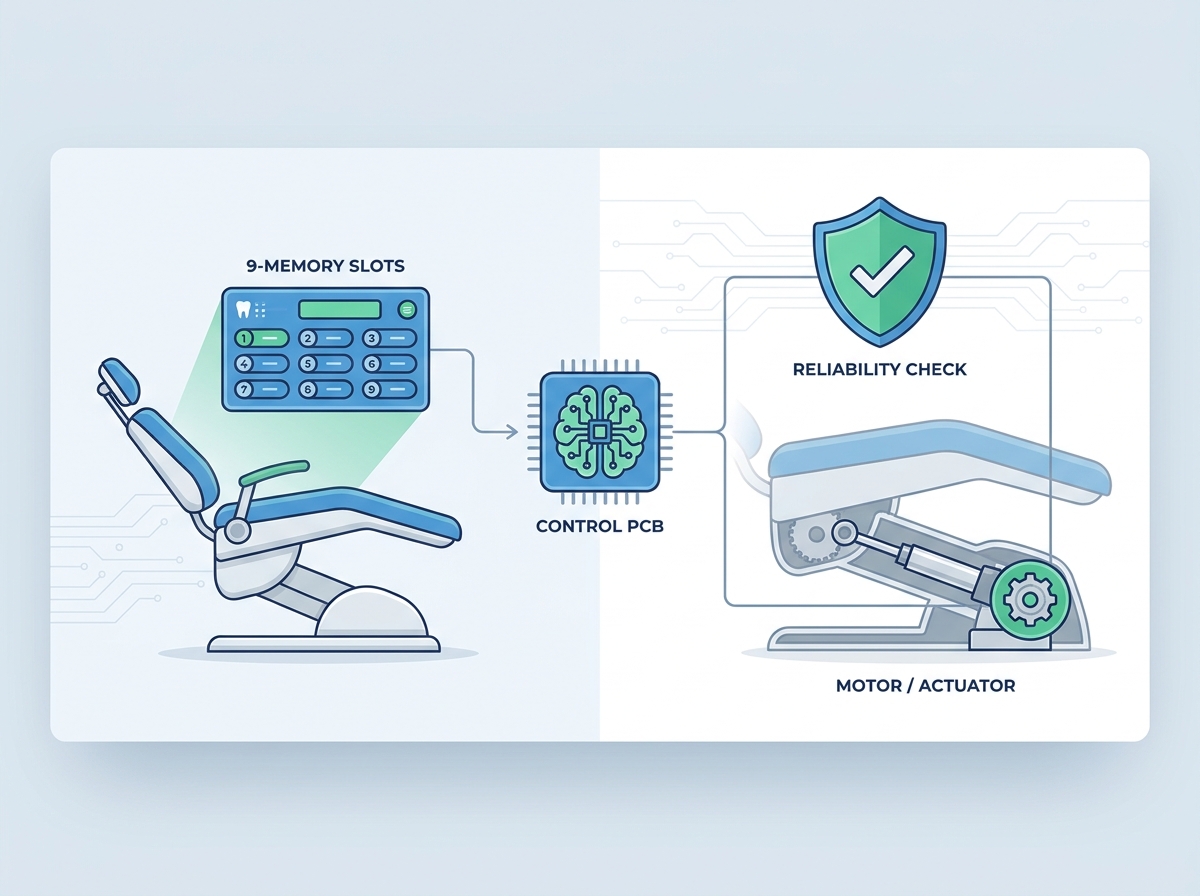
A high-functioning operatory operates as a cohesive ecosystem. The multi-memory chair acts just as the base. It must communicate flawlessly with the rest of the dental treatment unit. Without proper synchronization, the memory functions lose their practical value.
System synchronization dictates how well the chair interacts with delivery systems and lighting. Consider a practical clinical application. When you activate the "Spittoon Position", the chair moves the patient upright to rinse. Does the operating light automatically turn off? It should do this to prevent blinding the patient. Furthermore, does the chair return exactly to the previous working position when you press the button again? True integration handles these complex logic sequences effortlessly.
You can benchmark high-end configurations by referencing reliable hardware baselines. Looking at models like the KJ-915 dental unit provides a structural baseline. It helps you evaluate how manufacturers route water, air, and electrical systems through a multi-memory chassis. The internal plumbing and wiring must bend and flex thousands of times without pinching. A poorly designed chassis will damage internal hoses when cycling through extreme memory positions.
Modern clinics constantly adopt new technologies. You must ensure your delivery unit accommodates future add-ons. Examples include electric micromotors or intraoral scanners. Adding heavy attachments should not interfere with the chair's programmable ranges of motion. The control board must have enough processing bandwidth to manage new auxiliary devices safely.
Purchasing advanced equipment introduces new operational variables. Clinic managers must address hygiene, upkeep, and safety standards proactively.
Multi-button interfaces present unique hygiene challenges. Touchpads with 9 memory buttons must be seamless. They should feature membrane-covered designs. Alternatively, they must be easily barrier-wrapped. You clean these surfaces multiple times daily. They must withstand abrasive, hospital-grade disinfectants without degrading. Cracks in button panels harbor dangerous pathogens.
We must operate on a transparent assumption. Complex electronics inherently possess a higher theoretical failure rate than basic manual switches. More features equal more potential failure points.
You can implement specific risk mitigation strategies. Ensure the chair's upholstery is easily detachable. Technicians need quick maintenance access to the chassis wiring. If tracing a faulty wire requires dismantling the entire seat, your clinic will suffer severe downtime. Easy access lowers servicing costs.
Never compromise on documented safety standards. You must verify CE, FDA, or local regulatory certifications. Look specifically for the electrical safety ratings of the control boxes. Medical device manufacturers should adhere to strict quality management systems. Conformity to ISO 13485 standards indicates the factory follows rigorous testing protocols for their electronic medical devices.
Selecting the right supplier requires structured evaluation. Do not rely solely on sales pitches. You must move past the glossy brochure.
Effective shortlisting logic focuses on transparency. Request specific technical documentation from each vendor. Ask for wiring diagrams and component sourcing lists. Reliable manufacturers proudly disclose where they source their actuators and PCBs. If a vendor hides this information, they likely use inferior, unbranded components.
Arm yourself with targeted technical questions during negotiations. Ask the following:
"What is the warranty period specifically for the memory control PCB, distinct from the physical frame?"
"Are the linear actuators proprietary, or can they be replaced with standardized aftermarket parts?"
"Do you provide a comprehensive programming guide and remote troubleshooting for resetting memory limits?"
Do not buy complex equipment blindly. Request a live video demo focusing exclusively on the memory programming sequence. Watch how quickly the board registers new inputs. Alternatively, arrange a showroom visit. Bring your lead dental assistant along. Let them test the ergonomics of the touchpad and the responsiveness of the foot pedal.
A 9-memory dental chair transforms operatory efficiency in busy clinics. It standardizes workflows, reduces practitioner fatigue, and accelerates patient turnover. However, this transformation only succeeds if the underlying motors and electronics are robust enough for continuous, daily cycling.
We strongly recommend prioritizing vendors who demonstrate technical transparency. Choose suppliers open about their component sourcing. Ensure they offer robust warranties on the sensitive electrical systems, not just the physical steel frame.
Take action today. Audit your current operatory transition times. Calculate how many minutes you lose to manual chair adjustments. Then, request technical spec sheets from your shortlisted manufacturers to begin a confident, data-driven upgrade process.
A: No. Most modern units use a simple "Set -> Position Number" sequence. However, clinics should mandate standardized position mapping in their onboarding manuals. For example, assign positions 1-3 for Dentist A, and positions 4-6 for Dentist B. This prevents confusion.
A: Yes, it requires a digital control board capable of complex routing. You cannot easily retrofit a sophisticated 9-memory board onto an older, basic pneumatic chair chassis. The unit must natively support digital electrical signals.
A: Models in this category typically integrate memory positioning with safety lock-outs. This means the chair will not physically move if a dynamic handpiece is currently active. This essential safety feature protects the patient from accidental injury during procedures.
A: High-quality units include a manual override system. They provide basic directional buttons on the foot pedal. This allows the clinic to continue operating the chair manually while awaiting a replacement PCB, preventing costly operational downtime.


