
- All
- Product Name
- Product Keyword
- Product Model
- Product Summary
- Product Description
- Multi Field Search


Views: 0 Author: Site Editor Publish Time: 2026-10-14 Origin: Site


Many procurement teams fall into a common hardware trap. They assume maximizing LED count automatically guarantees superior clinical visibility. This surface-level specification rarely tells the whole story. Inadequate lighting creates severe downstream issues for dental practitioners. It leads to significant practitioner eye fatigue over long shifts. Poor illumination compromises accurate shade matching during aesthetic restorations. It also risks the premature curing of sensitive composite materials. You need a deeper understanding of optical performance today. Selecting the right dental chair operating light requires evaluating true clinical outcomes. You must analyze illuminance limits, Color Rendering Index (CRI), and physical integration. This approach moves beyond basic hardware specs to ensure diagnostic accuracy. We will explore how specific metrics directly influence restorative success. You will learn to evaluate mounting options and infection control features. Let us unpack the criteria that truly matter for clinical environments.
A high LED count does not guarantee diagnostic accuracy; precise color temperature (5,000K–5,500K) and a CRI above 90 are the true drivers of accurate shade matching.
Mounting configurations must align with clinic dimensions and existing equipment infrastructure to avoid workflow bottlenecks and drift.
Total Cost of Ownership (TCO) extends beyond the purchase price to include infection control efficiency, retrofit compatibility, and optical degradation over time.
Features like touchless operation and anti-polymerization modes are no longer premium add-ons but baseline compliance and workflow requirements.
Proper focal length and shadow reduction directly decrease clinician neck strain. Ocular fatigue drops significantly over a standard 40-hour workweek. Crisp light patterns allow you to maintain a neutral posture. You no longer need to lean awkwardly over the patient. The ciliary muscles in your eyes work less strenuously. They do not have to constantly adjust to uneven illumination gradients. This ergonomic advantage translates directly to sustained career longevity. We often see practitioners ignore lighting when addressing chronic back pain. However, visual constraints usually dictate your physical posture during procedures.
Quality lighting serves as a crucial risk mitigation tool. It prevents you from missing hidden caries during routine exams. Deep cavities often hide in the posterior regions of the mouth. Shadows can obscure these critical details from your view. High-fidelity illumination also reduces costly restorative failures. Incorrect shade selection frequently happens under poor lighting conditions. You want to avoid remaking crowns due to color mismatches. Better lighting ensures your initial diagnosis remains highly accurate.
Modern LED thermal management drastically outperforms legacy halogen systems. Older halogen bulbs generate excessive heat in the operatory. This heat creates severe discomfort for both you and the patient. Modern LEDs keep the patient completely comfortable during lengthy procedures. They emit virtually zero infrared radiation into the operating field. They also reduce the overall HVAC load in your clinic. We see immediate improvements in ambient room temperature control. Lower ambient temperatures prevent practitioners from sweating under protective PPE.
Buyers often fixate on the sheer number of diodes. However, evaluating a standard 12-LED dental oral light requires analyzing its optical array. How the array focuses light matters much more than diode count. Precision reflectors and lenses create the actual working field. A poorly designed 20-LED array might scatter light unproductively. A well-engineered smaller array will overlap beams to eliminate shadows. You must assess the convergence of these individual light sources. The final spot pattern should feature crisp edges without glaring halos.
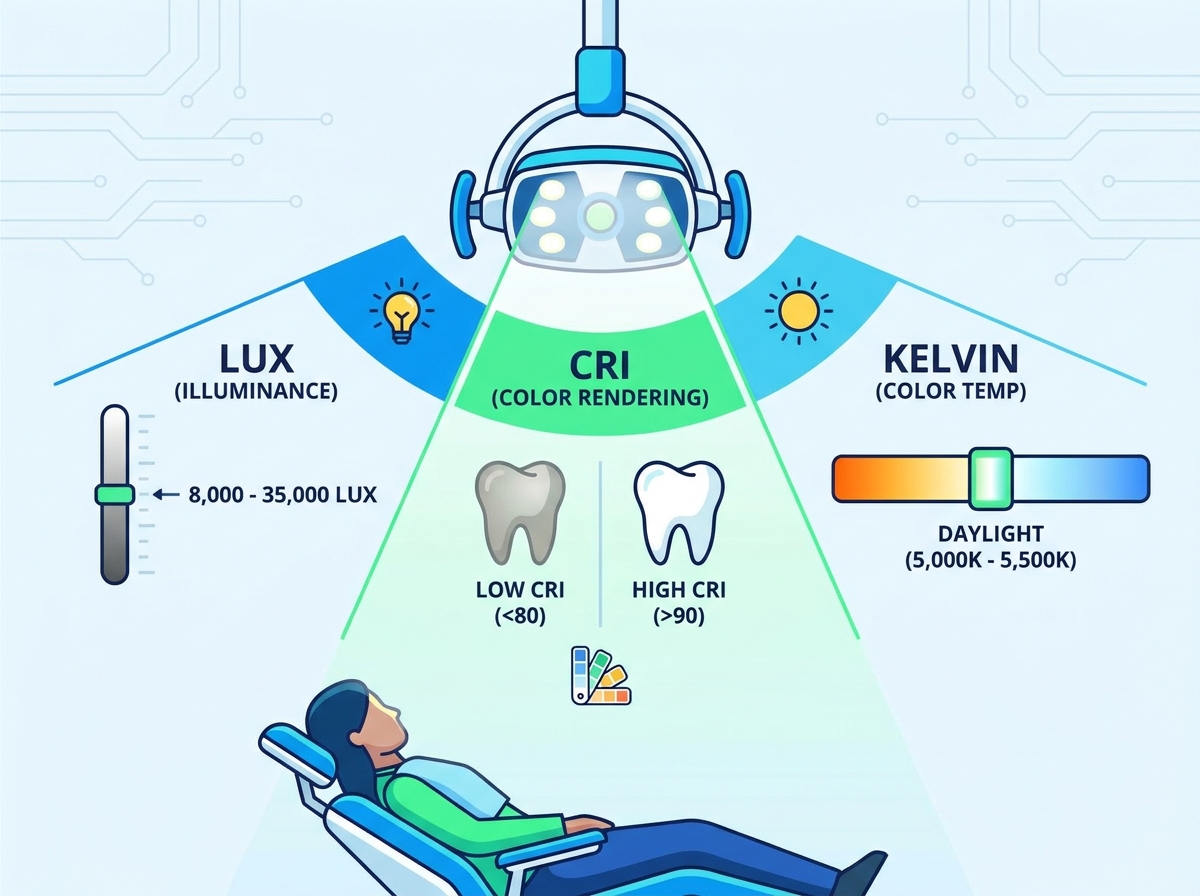
Baseline criteria require fully adjustable intensity ranges. We typically recommend a range between 8,000 and 35,000 Lux. This flexibility accommodates varying procedures seamlessly. You can perform complex surgeries without blinding the patient. Adjustable lux provides the exact brightness required for specific tasks. Routine exams might only require 15,000 Lux. Deep endodontic access often demands the full 35,000 Lux output. Industry standards dictate this range to maximize clinical versatility. It prevents retinal bleaching while ensuring clear visibility of margins.
A Color Rendering Index (CRI) above 90 is strictly non-negotiable. It allows you to distinguish subtle variations in soft tissue health. You can accurately identify restorative margins under high CRI lighting. Low CRI masks these critical details completely. It causes red tissues to look artificially dull or brown. A high CRI ensures the red spectrum renders accurately. This helps you identify inflammation or early-stage gingivitis immediately. Accurate color reproduction supports better overall diagnostic confidence.
The ideal color temperature mimics natural midday daylight. The sweet spot lands precisely between 5,000K and 5,500K. This range ensures highly accurate shade matching. It eliminates artificial blue or yellow tinting on teeth. Lower temperatures make composites look overly warm or yellow. Higher temperatures introduce a harsh blue cast. The 5,000K threshold aligns perfectly with standard VITA shade guides. It reduces the phenomenon of metamerism during restorative evaluations.
Clinical Lighting Specifications Reference
Metric | Recommended Range | Clinical Impact |
|---|---|---|
Illuminance (Lux) | 8,000 - 35,000 Lux | Ensures adequate brightness without causing patient glare. |
Color Rendering Index (CRI) | > 90 (Ideally > 95) | Crucial for identifying tissue health and margin details. |
Color Temperature | 5,000K - 5,500K | Provides daylight equivalent for accurate shade matching. |
Focal Distance | 700mm (approx. 27.5 inches) | Maintains crisp spot size at typical working distances. |
Chair-mounted units remain highly cost-effective and very popular. They conveniently move in tandem when you adjust the patient. This eliminates the need to reposition the light constantly. However, they carry a potential risk of chair vibration transmission. Compatibility with standard delivery systems is crucial for integration. We often use the KJ-917(20) dental chair unit as a benchmark. It demonstrates an ideal integrated post-mount setup. The post must support the light arm without excessive swaying. You must verify the post diameter before ordering a replacement light.
High-traffic operatories benefit immensely from ceiling and track mounts. Multi-provider clinics require a maximum range of motion. Track systems deliver this flexibility across the entire workspace. You can slide the light completely out of the way. You must assess your ceiling height before choosing this route. Structural reinforcement is a strict prerequisite for safe installation. Standard drop ceilings cannot support the weight of these arms. You will need dedicated backing plates secured to load-bearing joists.
Confined spaces often require alternative mounting solutions. Wall and cabinet mounts serve as excellent niche options. They work perfectly in specialized surgical suites or tight operatories. These mounts free up valuable floor space around the chair. They rely heavily on the structural integrity of your walls. Make sure your contractor installs heavy-duty blocking behind the drywall.
You must prioritize drift-free tension arms above all else. Smooth articulation ensures the light stays exactly where positioned. A drifting light severely disrupts clinical workflows. It forces you to break sterility to readjust the housing. Quality arms use robust spring mechanics or gas cylinders. These internal components counterbalance the weight of the light head. Test the arm by positioning it at extreme angles. It should hold its position without any downward sag.
Maintaining a strict sterile field is absolutely vital. Motion-activated power controls serve this essential function beautifully. Touchless intensity adjustments prevent dangerous cross-contamination between procedures. These sensors keep your hands strictly on the patient. You wave your hand to toggle modes or adjust brightness. This reduces the transfer of aerosolized pathogens to equipment surfaces. It also minimizes the degradation of physical switches over time. Sensor responsiveness must remain high even under bright ambient lighting.
Cleanability directly impacts your operatory turnaround time. Lights require sealed, seamless enclosures to prevent debris buildup. Dust and aerosols easily settle into open grooves or vents. Removable, autoclavable handles allow for rapid sterilization protocols. These geometric considerations streamline patient transitions significantly. A smooth exterior profile wipes down in seconds. Look for designs lacking exposed screws or deep crevices. Smooth housings resist the accumulation of stubborn biological matter.
Front shields must withstand harsh clinical-grade surface disinfectants. Scratch-resistant materials are necessary to prevent optical degradation. Poor quality shields often suffer from fogging or surface crazing. Chemical exposure breaks down inferior plastics very quickly. Clear shields maintain maximum light output over the long term. You should clean the shield using only approved, non-abrasive solutions. A cloudy shield severely diminishes your effective Lux output. It acts as an unwanted diffuser, scattering light away from the mouth.
Upgrading a light on an aging chair presents specific risks. You frequently encounter unexpected voltage mismatches during installation. Power supply limitations often complicate the entire process. Older halogen systems typically use alternating current (AC) transformers. Modern LED arrays require direct current (DC) drivers to function. You must ensure the new driver integrates with your existing chair. Non-standard mounting posts require custom adapters or costly modifications. Always measure the internal diameter of your current light post.
LED lumen depreciation remains a stark clinical reality. LEDs certainly outlast older halogen bulbs by many years. However, their light quality still shifts gradually over time. The phosphor coating on the diodes degrades after tens of thousands of hours. This degradation causes the color temperature to drift slightly. The overall maximum illuminance will also decrease over a decade. You must monitor this shift to maintain diagnostic standards. Schedule a routine lux assessment every few years.
Never evaluate a light solely on its marketing warranty. You must investigate practical parts availability instead. Focus specifically on replacing worn tension arm mechanisms. Internal driver availability is also crucial for long-term maintenance. Look for accessible components to minimize future downtime. A ten-year warranty means nothing if parts take months to arrive. You need a supplier who stocks replacement handles and shields domestically. Ask your dealer about the average turnaround time for repairs.
Follow these specific steps to streamline your evaluation process.
Audit the Operatory Environment: Start by measuring your existing mounting points carefully. Record precise ceiling heights across the clinic. Verify your power delivery compatibility before ordering. Document the locations of nearby cabinets to avoid collision zones.
Define Your Clinical Focus: Your specialty dictates your lighting priorities entirely. Restorative and cosmetic practices must weight CRI heavily. High CRI ensures perfect composite matching. Oral surgery demands maximum Lux and superior shadow reduction. Surgeons need deep cavity illumination without blind spots.
Assess the Mechanical Range: Observe how far the arm reaches across the chair. It must accommodate both supine and seated patient positions. The light head must rotate smoothly on multiple axes.
Request a Real-World Trial: Always request a hands-on trial period. Test arm drift under real clinical conditions. Evaluate the focal spot crispness yourself. Confirm sensor responsiveness during simulated procedures to ensure no false triggers occur.
An operating light functions as a critical diagnostic instrument. It is never just a basic hardware accessory. Decision-makers must prioritize essential optical metrics during procurement. CRI, color temperature, and mechanical stability outweigh surface-level specifications completely. You cannot rely on LED count alone to ensure visibility. High-quality illumination directly reduces daily eye fatigue. It also improves your overall restorative success rates significantly. Maximize your clinical efficiency by choosing well-engineered optical arrays. We urge you to consult with your equipment specialist promptly. Audit your current operatory lighting metrics carefully. Compare your existing setup against modern clinical standards. Upgrade your illumination to ensure optimal diagnostic accuracy today. You will feel the ergonomic benefits almost immediately.
A: The industry standard focal distance is typically around 700mm or 27.5 inches. This specific distance ensures a crisp light pattern at the oral cavity. It provides maximum illumination intensity where you need it most. Furthermore, it prevents the light head from physically obstructing the practitioner's workspace. You can maintain a comfortable posture without bumping your head during procedures.
A: These specialized modes temporarily filter out the blue light spectrum. They specifically target wavelengths around 450nm. This filtering prevents the premature polymerization of sensitive composite resins. You can confidently place and sculpt materials without rushing. Practitioners retain enough visibility to work efficiently while the anti-cure mode remains active.
A: Retrofitting is quite common, but it requires strict verification. You must measure the mounting post diameter first. You also need to ensure the existing chair's power supply matches the new LED driver requirements. Check whether your system provides AC or DC voltage output. Some upgrades require an external power converter to function safely.
A: Poor reflector design often fails to converge light correctly. Misaligned LED arrays also cause multiple distinct shadows. When light sources do not overlap perfectly, hands or instruments block individual beams. You must evaluate the "shadowless" rating of the optical design. High-quality lenses overlap beams to prevent these frustrating visual obstructions entirely.


